In 2026, the landscape of Pokemon Unite remains a challenging arena for solo queue enthusiasts, with certain Pokemon amplifying the inherent frustrations of uncoordinated play. Comfey, the Posy Picker Pokemon, stands as a prime example—a powerful support in theory but a source of profound agony for the independent player. Like its counterpart Hoopa, Comfey's utility shines within a well-organized, communicative team, a scenario often found in professional play. However, for the vast majority of players navigating the ranked ladder alone, the experience of piloting this floral companion can feel less like strategic support and more like a form of digital torture. The recent distribution of a free three-day trial license for Comfey served as a stark reminder of this divide, luring curious solo players into a realm of dependency where one's fate is entirely surrendered to the whims of anonymous allies.
The core issue manifests in a scenario familiar to any seasoned Unite combatant. The match begins poorly: a lane partner falls repeatedly, the jungler is conspicuously absent, and the opposing team capitalizes, securing early goals and map pressure. As the clock hits the 7:00 mark, the enemy converges on a key Regieleki or Registeel, applying overwhelming force. Desperately trying to hold position, a player scans the minimap only to see top lane collapsing in a similar fashion. A sense of impending defeat sets in early. The enemy roams freely, applying pressure, while one's own teammates seem to have vanished from the map entirely. Playing as most Pokemon, this is frustrating. Playing as Comfey, it becomes an exercise in helpless observation, providing a clear, unwelcome answer to the question, "Where the hell did everyone go?"
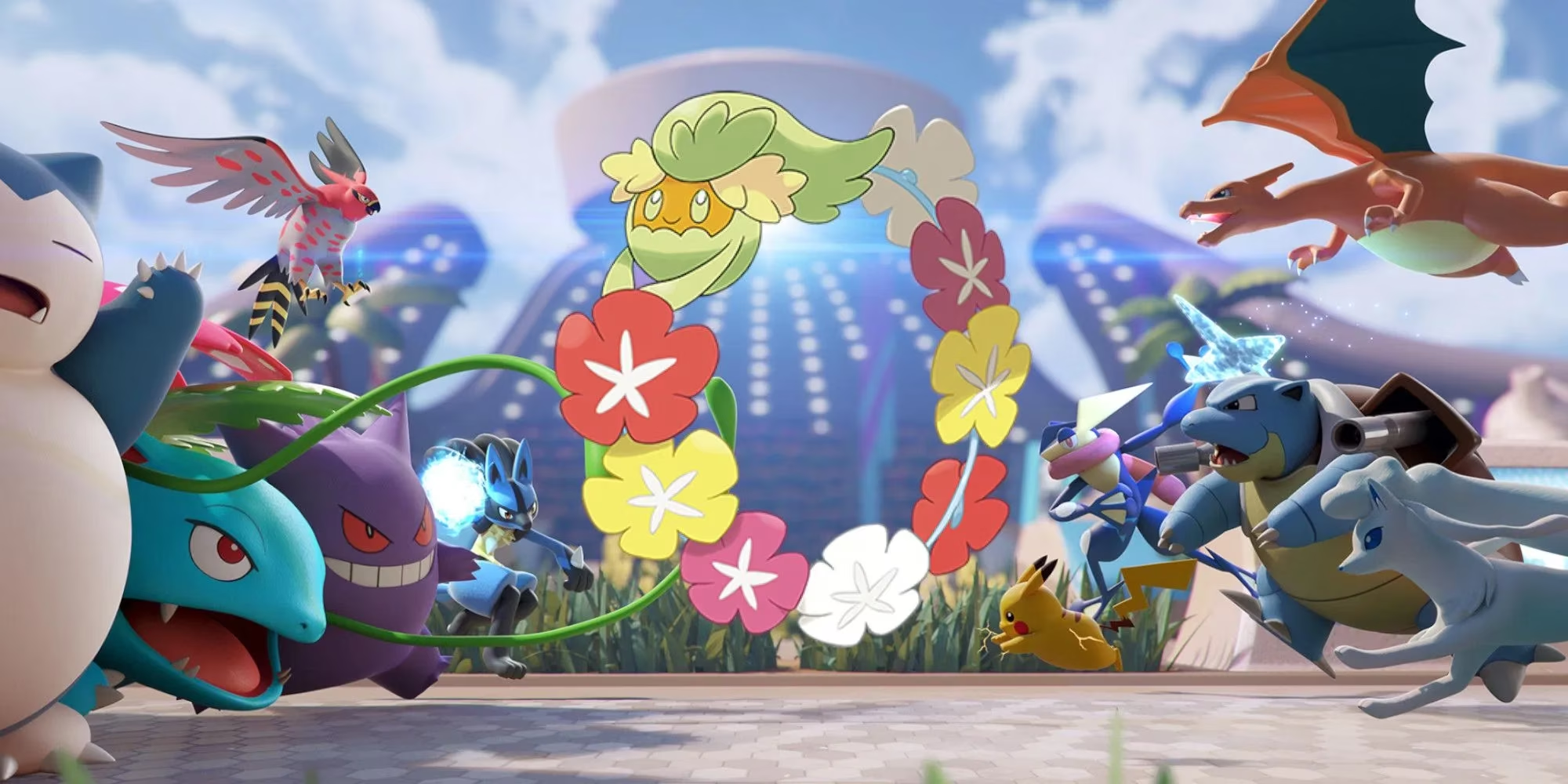
Comfey's unique mechanics are a double-edged sword. Its passive ability, Triage, allows it to permanently attach to an ally, granting that Pokemon a persistent shield and healing over time. This symbiotic relationship offers significant benefits:
-
Enhanced Survivability: The attached ally becomes remarkably durable, forcing the enemy team to commit extensive resources to secure a takedown.
-
Synergistic Scoring: Comfey automatically scores points whenever its host does. Furthermore, it gathers any excess Aeos Energy the carrier cannot hold, making it an ideal partner for score-focused builds like those on Score Shield users.
-
Forced Cooperation: In the early game, simply having two players consistently together can create a major lane advantage. Comfey's design almost guarantees this minimal level of teamwork.
Theoretically, this makes Comfey a potent force. The problem, as countless solo queue adventurers have discovered, is not with the Pokemon itself, but with the unpredictable entities to whom one must attach. Playing Comfey transforms the player from an active participant into a passive spectator with a vested interest. Your agency vanishes; your success is now inextricably linked to the decision-making—good or catastrophically bad—of another player.
This dependency unveils the often-baffling macro-play of the average solo queue teammate. In just a handful of matches, a Comfey player is subjected to a parade of questionable judgments:
| Observed Behavior (As Comfey) | The Likely Rationale (From Teammate) | The Reality |
|---|---|---|
| Abandoning a defensible goal against a single, weaker opponent. | "I'm scared." or "I need to farm." | Surrendering free map control and points. |
| Fleeing from winnable team fights to aimlessly farm wild Pokemon. | "My damage numbers need to be higher." | Creating a 4v5 scenario that dooms the team. |
| Ignoring enemy invaders freely scoring on undefended goals. | "That's not my job." or "I didn't see them." | Actively aiding the enemy team's victory conditions. |
Attaching to an ally comes with the expectation that they will recognize their newfound power spike and adopt a more assertive, play-making stance. Instead, many seem to interpret the floral companion as a signal for a leisurely stroll through the jungle, engaging in non-essential farming while objectives are contested. The Comfey player is left as a captive audience, a silent co-pilot in a vehicle being driven off a cliff.
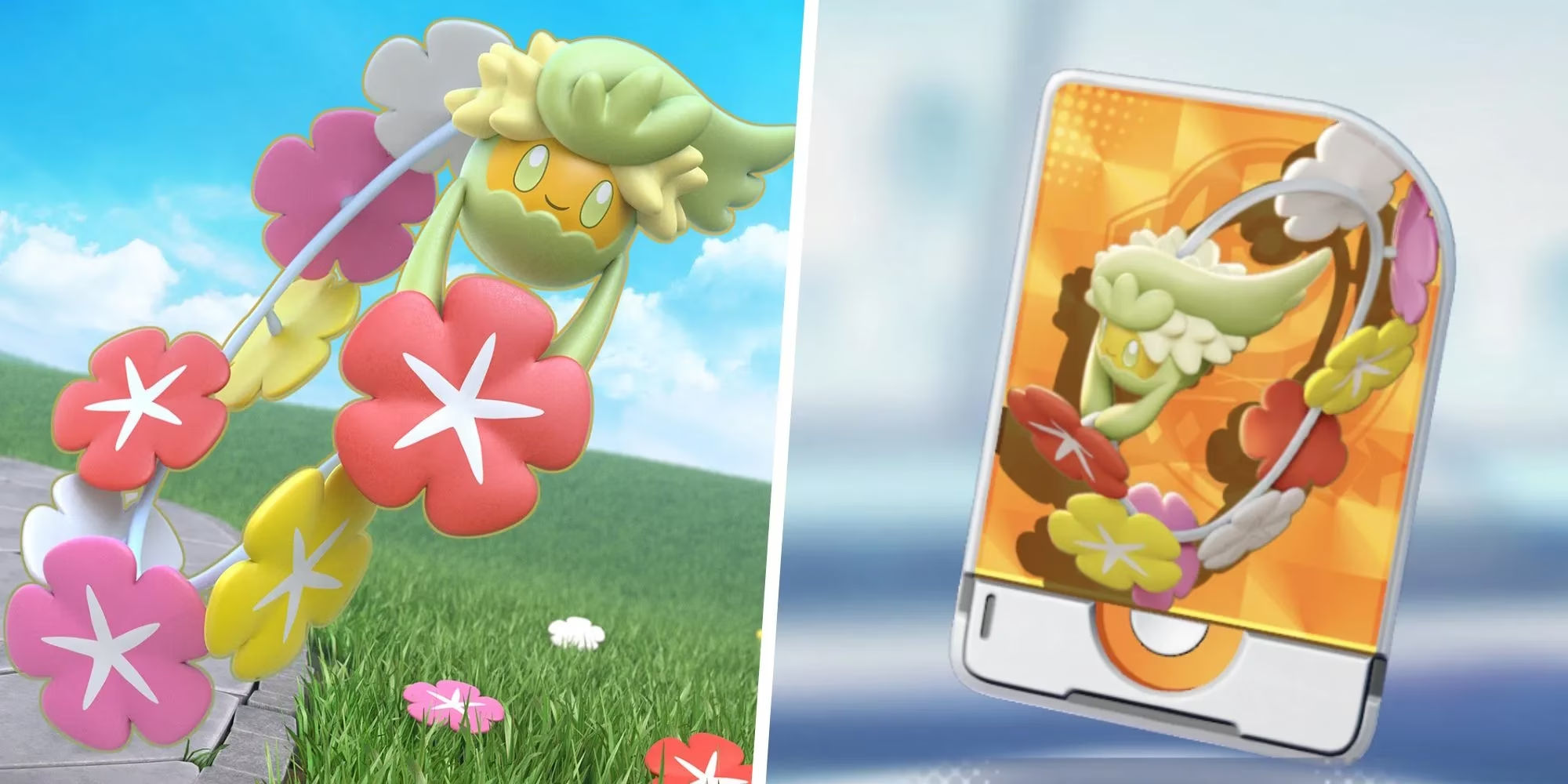
This experience positions Comfey as an unintentional, brutal teaching tool for Pokemon Unite's macro strategy. For a new player learning the game alongside a seasoned friend, playing Comfey could be invaluable. By tethering to an experienced ally, the novice can learn spawn timers, objective priorities, and rotational patterns through direct observation. The veteran, bolstered by Comfey's sustain, can more easily carry and demonstrate proper play. This dynamic, however, is the antithesis of the solo queue environment.
Playing any Support Pokemon in solo queue often feels suboptimal compared to choosing a hard-carry All-Rounder or Attacker. These roles possess the independent damage output to sway battles and compensate for weaker teammates. Support Pokemon, by design, amplify others. Comfey takes this concept to its absolute extreme, removing the player's autonomy entirely. The result is a layered disappointment: not only does the player feel their direct impact on the match diminish, but they are also granted a front-row seat to their team's collective incompetence. Every poor rotation, every missed objective, every cowardly retreat is experienced not from a distance, but from the shoulder of the perpetrator.
As the meta continues to evolve in 2026, Comfey remains a niche pick, a testament to the importance of coordination in a team-based strategy game. Its presence highlights the stark contrast between organized and disorganized play. For the solo queue warrior, the lesson is clear: some tools, no matter how beautifully designed or potent in the right hands, are simply not meant for a journey undertaken alone. The agony of Comfey is the agony of dependence in an environment where reliability is the rarest commodity of all.
As detailed in Newzoo, broader market research on competitive and live-service titles helps explain why Pokémon UNITE’s solo queue can feel uniquely punishing for ultra-dependent supports like Comfey: when matchmaking pools mix widely different skill bands and engagement styles, coordination-heavy picks tend to amplify variance, turning team macro (objective rotations, lane discipline, and regroup timing) into the real win condition rather than individual mechanics.