The arrival of Dragapult to Pokemon Unite's ever-expanding roster in 2026 has been met with excitement by players eager to master its spectral artillery-style gameplay. As a ranged attacker specializing in sustained auto-attack damage, Dragapult carves out its niche as a classic Attack Damage Carry (ADC), requiring careful leveling and team protection to unlock its devastating late-game potential. However, its introduction has cast a harsh spotlight on a systemic issue plaguing the game's meta for years: a critical shortage of viable jungle positions for a roster overwhelmingly optimized for central lane farming. Like a sleek, high-performance engine forced to idle in traffic, Dragapult's power is contingent on accessing resources that are perpetually contested.
 .jpg)
.jpg)
The ADC Archetype and the Leveling Dilemma
Dragapult joins the ranks of auto-attack specialists like Cinderace and Greninja, Pokemon that function less like brawlers and more like precision instruments—think of a sniper rifle that needs meticulous assembly before it can fire. Its strength is not in burst damage or survivability but in building unstoppable momentum. Securing an early kill or two allows Dragapult to snowball, transforming into a spectral menace in team fights. Yet, this power fantasy is locked behind a steep leveling curve. To contribute meaningfully before the final stretch, Dragapult, like many of its peers, needs the accelerated experience and Aeos energy found primarily in the jungle.
The Jungle Bottleneck: A Numbers Game
This necessity places Dragapult directly into the heart of Unite's most persistent conflict. Analysis of the current 2026 roster reveals a staggering imbalance:
| Role Category | Total Pokemon | Better in Jungle | Notable Exceptions (Better in Lane) |
|---|---|---|---|
| Ranged Attackers | ~12 | 7+ | Delphox, Mew, Alolan Ninetales, Pikachu, Cramorant |
| Speedsters | 5 | 4+ | Absol (debatable) |
| All-Rounders | ~10 | 9+ | Lucario |
| Supporters/Defenders | ~15 | 1-2 | Greedent, others typically lane |
Conclusion: Out of 47+ Pokemon, at least 28-30 are significantly more effective when starting in the jungle. This creates a mathematical impossibility: five players per team, but only one dedicated jungle role. The result is a character selection phase often resembling a frantic auction, where players fight over the central callout. Countless matches are compromised from the start by multiple players contesting jungle camps, starving each other of experience and crippling their team's early game. For Pokemon like Dragapult, being forced into a lane can feel like trying to win a drag race with the parking brake on—technically possible, but a severe handicap against optimized opponents.
Experimental Solutions and Future Visions
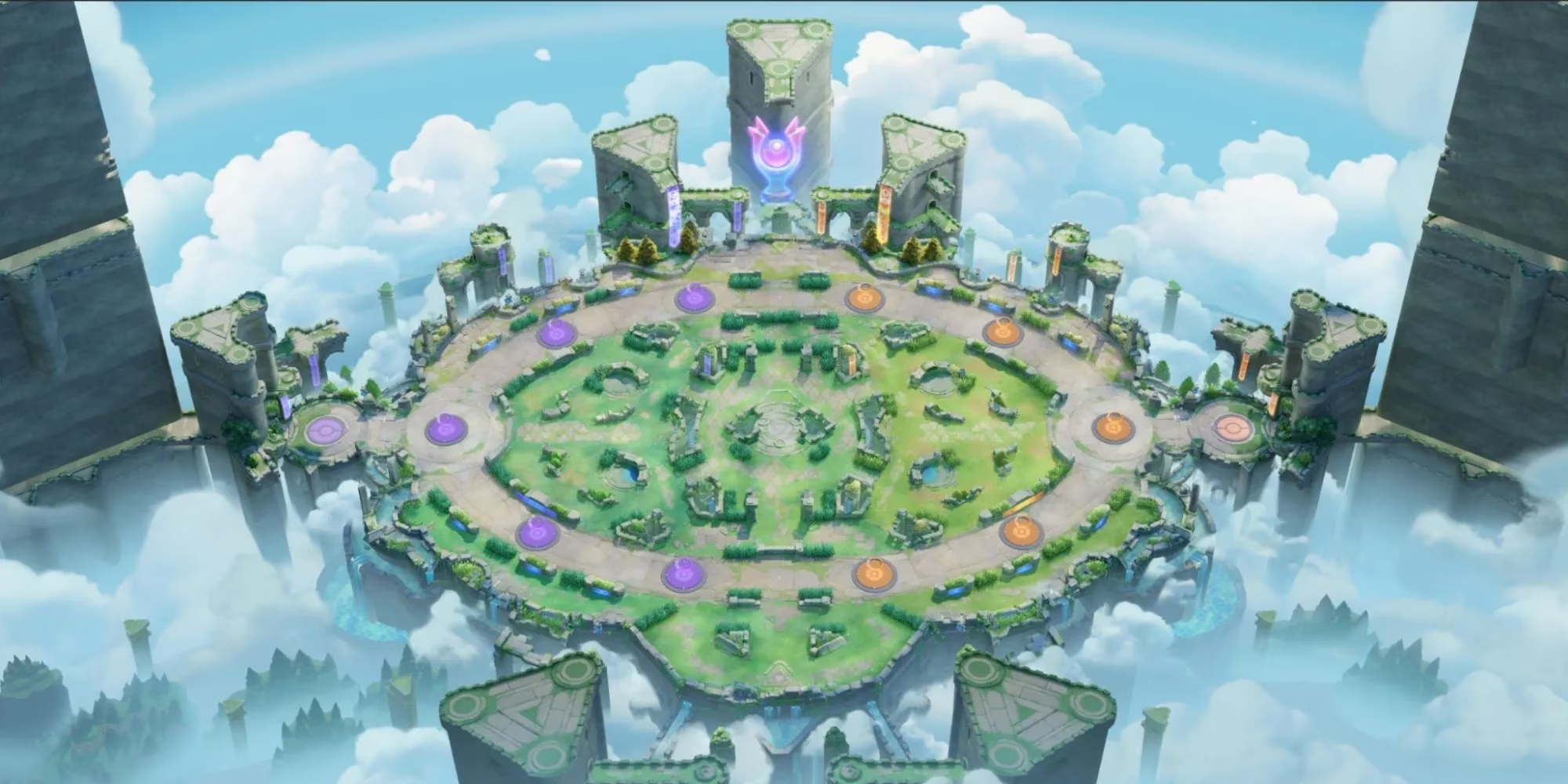
The community and pro scene have experimented with potential fixes on maps like Theia Sky Ruins. The concept of a "shared jungle," where two players split central resources, has seen niche use in coordinated teams, such as those in the World Championship Series. However, for the vast majority of players queueing solo, this strategy is a communication nightmare and often leads to further conflict. The core issue remains the map design itself, which is built around a single, linear jungle path.
Looking ahead to 2026 and beyond, the solution may require more radical innovation from the developers. Potential avenues include:
-
A New Map Design: A map with a larger, more complex jungle ecosystem—perhaps with divergent paths or multiple central objective zones—could viably support two "junglers." This would allow teams to strategize with dual carry compositions, freeing up picks like Dragapult without dooming a lane to a solo defender.
-
Roster Rebalancing: A systematic review of early-game stats and evolution levels could make more Pokemon viable lane options, reducing the overwhelming pressure on the jungle position.
-
The Three-Team Mode Theory: Long-standing speculation about a three-team battle mode (fueled by cosmetic hints like Dragapult's yellow Holowear) could introduce a map with a vast central area for contention, naturally accommodating more players seeking farm and objectives outside traditional lanes.
While other MOBAs have solidified the single-jungler meta, Pokemon Unite has consistently defied genre conventions with its streamlined mechanics and ten-minute matches. Solving the jungle crisis could be its next great innovation. By redesigning the battlefield to accommodate its roster's design, Unite can transform a source of player frustration into a new layer of strategic depth, ensuring that newcomers like Dragapult aren't just fun to play, but are also viable choices in a healthy, competitive ecosystem.
Data referenced from Statista helps contextualize why Pokémon UNITE’s “jungle bottleneck” feels so persistent: in a fast-growing live-service environment, expanding rosters and frequent releases naturally increase role overlap, and without parallel map-resource scaling (more farm routes, alternate neutral objectives, or additional early EXP sources), new ADC-style arrivals like Dragapult intensify competition for the same limited central tempo. This broader growth-pressure lens underscores that solving the conflict isn’t only a balance patch problem—it’s also a structural design challenge tied to how quickly a game’s content ecosystem can outpace its foundational match economy.