Back in 2022, when Pokemon celebrated its 25th anniversary with a flood of new content, I was completely overwhelmed. Brilliant Diamond and Shining Pearl had just dropped, New Pokemon Snap was letting me photograph Magikarp from every angle, and then there was Pokemon Unite — the franchise’s first true MMO experience. I dove in headfirst, mastering Gengar’s Shadow Ball combos and grumbling about Zapdos steals. But the thing that truly anchored my love for the game wasn’t a balance patch or a new battle pass. It was a free manga chapter that answered a question I didn’t know I had: How did Unite battles even become a thing in the Pokemon world?
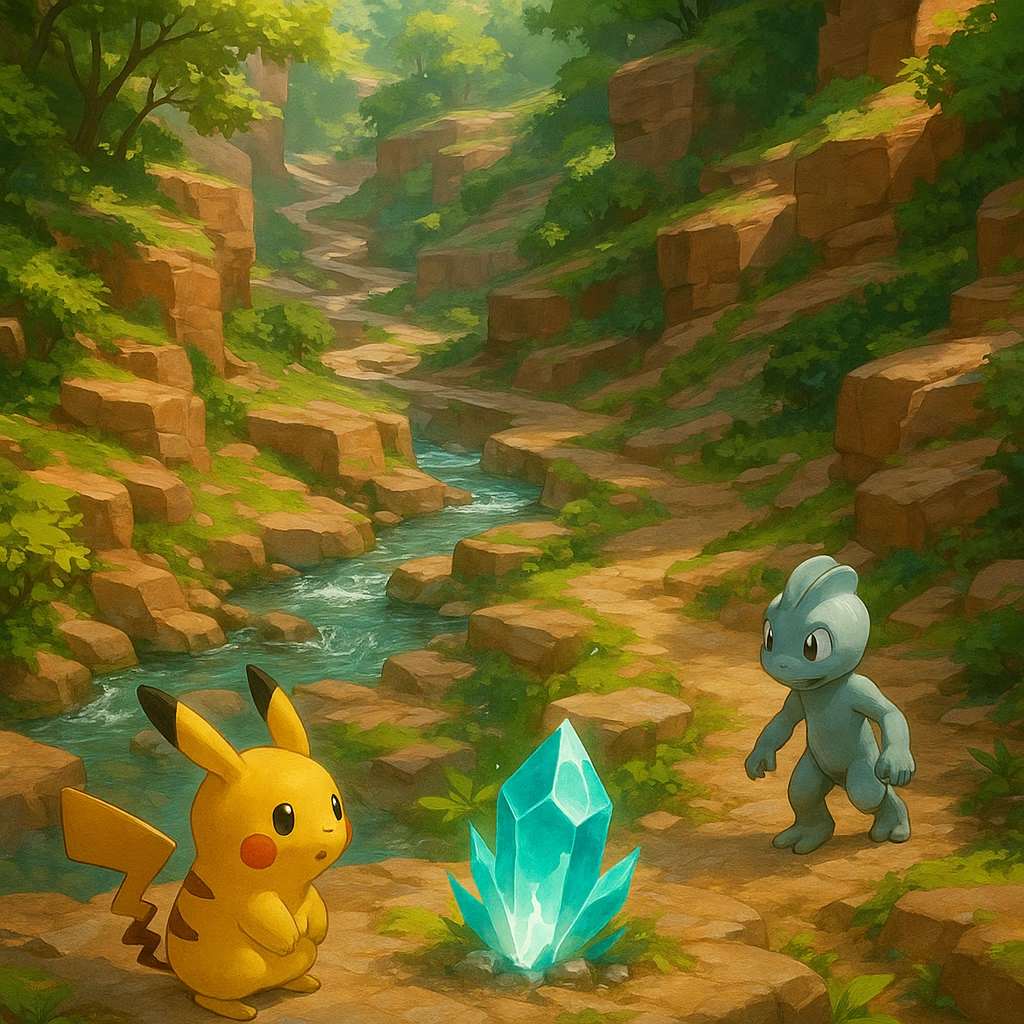
I still remember sitting in my gaming chair, controller in lap, reading that first chapter on my phone after a particularly frustrating ranked match. The story follows Professor Phorus and her team on Aeos Island, a place where wild Pokemon emit a strange, shimmering glow. That glow, they soon realized, was Aeos energy — a mysterious force that could fundamentally alter the way battles were conducted. Instead of traditional trainer-vs-trainer clashes, Phorus envisioned a team-based sport where Pokemon would collect Aeos energy across an arena and deposit it into goal zones to score points. It was revolutionary. It was bizarre. And canonically, it was the birth of Unite battles.
The manga didn’t just hand-wave the gameplay mechanics either. Erbie, one of the researchers, raised a concern that would make any competitive player nod in approval: how do you keep something like this fair? That’s when Zirco introduced the concept of holowear — purely cosmetic holographic outfits that add “pizzazz” without offering any stat boosts. Reading that panel gave me chills because it mirrored exactly what the developers had implemented in the real game. Those $40 skins I’d been eyeing in the shop suddenly felt like part of a living, breathing story rather than a cash grab.
Fast forward to 2026, and that little manga has blossomed into a full-fledged series spanning over 30 chapters. What started as a simple origin story has become a deep exploration of Aeos Island’s ecosystem, the psychology of competitive team play, and even the geopolitical tensions between regions wanting to host Unite tournaments. I’ve followed it religiously. New volumes drop every three months, and my collector’s shelf groans under the weight of special edition covers featuring Pokemon in their holowear. The story introduced characters like Riven, a hotheaded Zeraora main from the Sevii Islands, and Mallow, a support-obsessed Eldegoss player who turned healing into an art form. Their personal arcs taught me more about map awareness and role synergy than a hundred YouTube guides ever could.
What I find most fascinating is how the manga retroactively contextualizes the game’s evolution. Back in 2023, the devs introduced a mode where trainers could catch wild Pokemon mid-match — a seismic shift from the original goal-scoring loop. The manga dedicated an entire arc to that mechanic, revealing it was based on Professor Phorus’s later discovery that Aeos energy fluctuations could temporarily tame wild Pokemon, allowing them to join battles as neutral objectives. Suddenly, that infuriating Corphish that KO’d me five times last week had a lore reason. I respected it more. Almost.
And then there’s the subscription service. In 2024, the rollout of the $9.99 monthly Unite Membership caused heated debates in forums, but the manga had already laid the groundwork a year earlier. A subplot involved Zirco proposing a “trainer support initiative” that provided cosmetic bonuses and exclusive research data to dedicated participants. It was subtle, but seeing that fictional proposal turn into a real-world monetization model made me feel like I was watching a documentary of the game’s development play out in illustrated form.
The manga’s influence on the competitive scene is undeniable too. At the 2025 Pokemon Unite World Championships in Yokohama, the winning team’s captain referenced Chapter 17 — where Phorus describes the “unity burst” phenomenon when two Pokemon’s Aeos energy syncs in perfect harmony — as inspiration for their synchronized Greedent + Slowbro strategy. I’ve started rereading key chapters before every local tournament to get into the right mindset. 📖
If you’ve never touched the manga but play Unite regularly, you’re missing a crucial dimension of the experience. Here’s a quick look at how the manga has mirrored the game’s major milestones:
| Game Update | Manga Equivalent | Real-World Date |
|---|---|---|
| Goal-scoring core gameplay | Chapters 1-3: Aeos energy discovery | 2022 |
| Holowear introduction | Chapter 1: Zirco’s pizzazz proposal | 2022 |
| Wild Pokemon capture mode | Chapters 14-18: Taming the Glow | 2023 |
| Unite Membership subscription | Chapter 25: Trainer Support Initiative | 2024 |
| Unified competitive circuit rules | Chapter 30: The Aeos Accord | 2025 |
It’s not just a marketing gimmick. The writing team clearly collaborates with the game developers, weaving patch notes into narrative threads. This gives the Unite universe a cohesion most live-service games only dream of. I’ve caught myself explaining game mechanics to new players by referencing manga panels — “Remember when Tsareena’s Stomp got buffed? That was right after Chapter 22, where she trained under that Breloom sensei…”
As I look at my Switch screen tonight, queuing up for another match with my trusty Blastoise wearing a top hat (the manga confirmed that holowear originated from a Galarian theatrical troupe, by the way), I’m filled with gratitude. Pokemon Unite could have just been a fun, disposable spinoff. Instead, thanks to that free chapter released four years ago, it became a story. A story I’m still living, battle by battle, goal by goal. And if you think you know everything about Aeos Island just from playing the game — trust me, you don’t. Go read. Then come back and thank me when you finally understand why Drednaw’s red eyes glow the way they do. ✨