As a professional gamer, one is constantly reminded of the sheer scale of League of Legends. Every Riot event, like the recent promotional gathering at the Red Bull Gaming Sphere in London, reinforces this fact with its vibrant energy. The venue was alive with bright neon lights, the iconic 'Get Jinxed' track pumping through the speakers, and fans dressed as Jinx and Ekko mingling about. It was here that players got their first hands-on experience with Convergence: A League of Legends Story, developed by the indie studio Double Stallion. Sitting down to play, one couldn't help but wonder: how does a smaller studio adapt to the immense expectations surrounding such a titanic IP? This question set the stage for a deeper conversation with the creators themselves.
The Unlikely Partnership: Riot Forge Meets Double Stallion
The story begins not with a grand plan, but with a festival submission. Double Stallion, a UK-based studio known for 2D action titles like Speed Brawl, caught the attention of Riot Forge almost by accident. Daniel Ménard, the CEO, recalls the moment vividly: "When we launched Speed Brawl, we submitted it to a few festivals, and along the way, someone at Riot Forge played the game. They liked the style and the way we were expressing action gameplay and then they contacted us asking if we’d like to do something in the League of Legends universe." The offer was a shock—Ménard's initial reaction was one of disbelief: "I was like, ‘We get to work on something in League of Legends, are you kidding me?’" This wasn't a studio of die-hard League fans, but they all recognized the IP's magnitude. The beauty of Riot Forge's approach? They imposed no restrictions. The message was clear: "We really like what you do, we like the way you develop your games. It was up to us to decide what story we wanted to tell."
Why Ekko? Unlocking Time Rewind in an Action Game
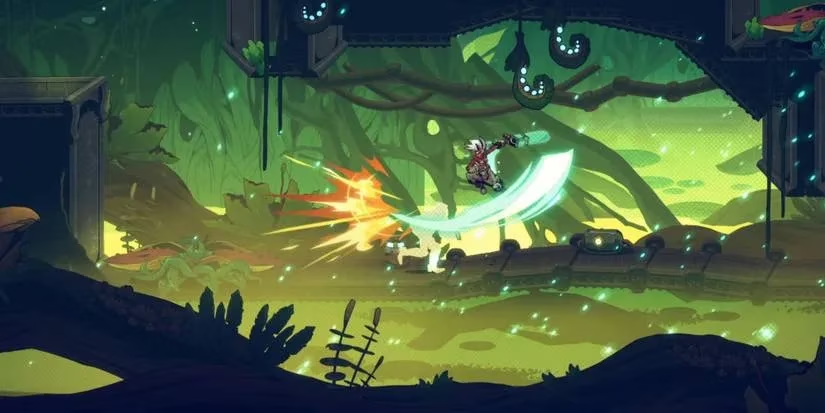
With the entire vast world of Runeterra at their fingertips, why did Double Stallion zero in on Ekko? The answer lies in pure gameplay potential. Ménard explains, "The champion that resonated the most with us was Ekko. He’s a fan favourite, and his time rewind ability isn’t fully explored in the MOBA because it’s a player-versus-player game. We had the chance to explore rewinding time in an action game." Think about it: most time-manipulation mechanics in gaming are reserved for puzzle or narrative-driven experiences. But what if you could rewind a frantic combat scenario, correcting a mistimed dodge or unleashing a perfect combo? The team was electrified by this possibility. They even built an early proof-of-concept within Speed Brawl, retooling their existing networking rollback code to create a rewind-on-button-press mechanic. "We messed around with it and thought ‘This has the potential to be very cool.’ That’s what kind of sparked it, and everyone said 'Yeah, we’re doing Ekko,'" Ménard said. It was a perfect match of champion fantasy and studio expertise.
Creative Freedom and Respect for the Lore
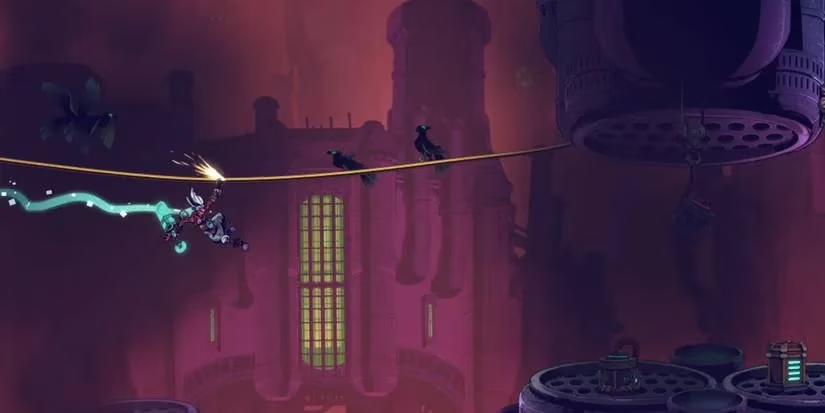
One might assume that working with a giant like Riot comes with a heavy-handed creative director. However, Senior Producer Thomas Mir dispels that notion. "Riot Forge isn’t in the business of dictating how Double Stallion makes its game," he states. "They were chosen for a reason." Riot Forge's philosophy is to seek out unique voices, not to replicate what already exists. They approached Double Stallion specifically for their signature style: fast-paced, action-packed gameplay and vibrant, eye-catching visuals. "They didn’t come to us because we know the world, they came for the type of game we create," Mir emphasizes. The onus was then on Double Stallion to immerse themselves in Ekko's story and the world of Zaun. They hired lore experts and collaborated closely with Riot's narrative team to ensure authenticity. The result? A game that feels true to Ekko's character—a scrappy, inventive hero from the undercity—while delivering the kinetic thrill Double Stallion is known for. Isn't that the ideal collaboration? A studio brings its core strengths, and the IP holder provides the world and support to flesh it out faithfully.
The Riot Forge Strategy: Curating Unique Indie Experiences
Convergence isn't an outlier; it's part of a deliberate and successful strategy. By 2026, Riot Forge has firmly established itself as a curator of premium indie experiences within the League universe. Before Convergence, they published titles like:
-
Ruined King: A turn-based RPG delving into the Shadow Isles saga.
-
Hextech Mayhem: A rhythm-based platformer starring Ziggs.
-
The Mageseeker: An action RPG exploring Sylas's rebellion in Demacia.
Each game explores a different genre and champions a different champion, proving that League's lore is a versatile playground. Riot Forge's role is to identify talented studios—like Airship Syndicate or Double Stallion—and give them the tools and trust to execute their vision. This model benefits everyone: players get diverse games, indie studios get exposure to a massive audience, and the League universe grows richer. With Convergence's release, the portfolio only becomes stronger, offering a 2D action-platformer where time itself is your weapon.
Looking Ahead: The Legacy of Convergence and Indie Collaborations
As Convergence: A League of Legends Story takes its place in the pantheon of Riot Forge titles, it stands as a testament to successful collaboration. For players in 2026, it's a thrilling action game that deepens their connection to Ekko. For the industry, it's a case study in how major IP holders can empower, rather than stifle, creative indie talent. Double Stallion took a core mechanic from their previous work, saw its potential in a new context, and, with Riot's blessing, built an entire game around it. They weren't hired to make a "League game"; they were hired to make a Double Stallion game set in League. That distinction is everything. So, the next time you rewind time in Convergence to nail a perfect platforming sequence or outmaneuver a boss, remember: this experience was born from a studio's unique spark, given space to flourish within one of gaming's biggest worlds. What other champions and genres might Riot Forge explore next? Only time will tell, but if Convergence is any indication, the future looks brilliantly diverse.