As a regular Mobile Legends: Bang Bang player, I never thought a legal framework could make my heart race faster than a new hero reveal. But when I watched the announcement from the New Global Sports Conference in Riyadh, something shifted. MOONTON Games, the publisher behind MLBB, had adopted the International Games and Esports Tribunal (IGET) framework as the standard for dispute resolution across its global ecosystem. I was sitting in a crowded internet café in Jakarta, sipping iced tea, and for a moment the noise around me faded. That sentence sounded like a promise: the game I love might finally grow up.
I have seen too many disputes vanish into Discord arguments. A few seasons ago, my friend joined a community tournament. The opposing team used a smurf account, the organizer shrugged, and the prize money disappeared. My friend never got an apology. That memory still stings.
So when I heard about IGET, I leaned closer to my screen.
IGET is not just another committee. It is a not-for-profit body established by the Esports Integrity Commission (ESIC) in partnership with the World Intellectual Property Organization Arbitration and Mediation Center (WIPO AMC). That combination matters. ESIC understands esports integrity, while WIPO AMC understands intellectual property. Together, they created a specialized Alternative Dispute Resolution (ADR) service tailored to gaming and esports. Its panel includes global experts from gaming, esports, and IP law. IGET handles disputes about competitive integrity, contracts, and IP conflicts. For a mobile esports ecosystem as huge as MLBB, that is a big deal.
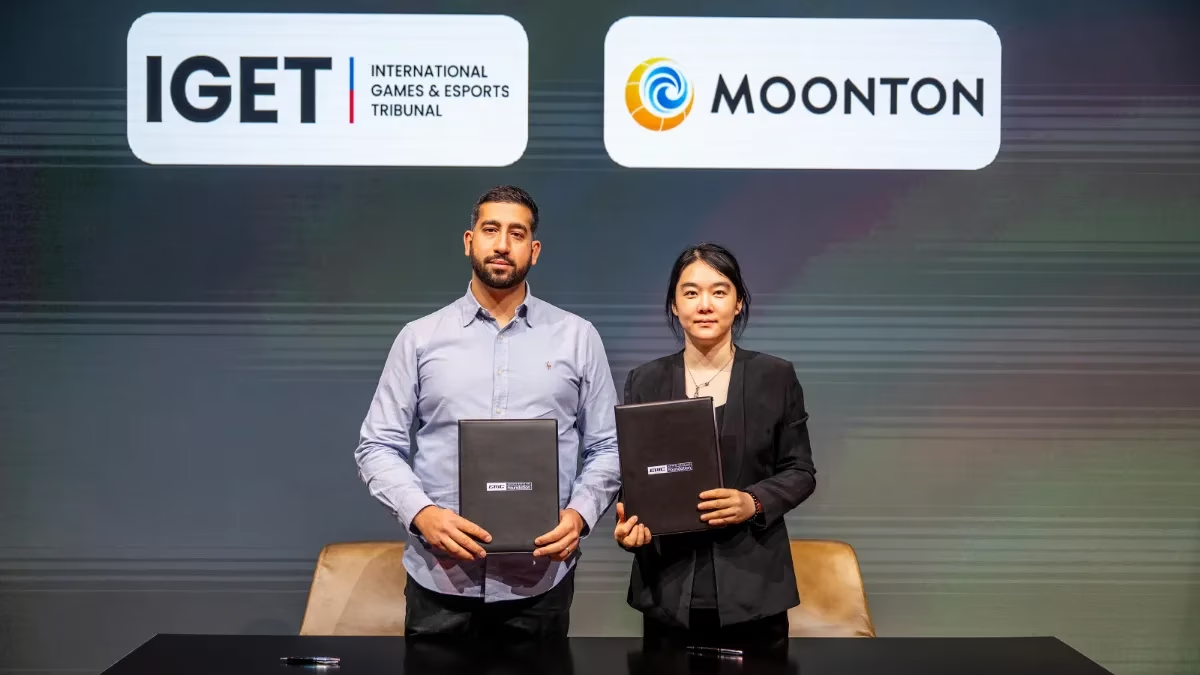
Stephen Hanna, Executive Director of the International Games and Esports Tribunal, said, 'We welcome MOONTON Games’ adoption of IGET’s framework as a forward-looking step in strengthening governance across the esports industry. By choosing IGET, MOONTON Games sets a positive precedent for how publishers can rely on IGET’s professional, independent, and purpose built dispute resolution processes.'
When I read that, I thought about all the times players, teams, and even small organizers had no neutral place to go. Social media was the courtroom. Screenshots were the evidence. Followers were the jury. It was exhausting.
Cherry Xia, Head of Publishing at MOONTON Games, added, 'We believe that strong governance and professional standards are the foundations of sustainable growth of esports. Adopting IGET’s framework reaffirms our commitment to fairness and integrity. Most importantly, it reflects our pledge to create thrilling game experiences, while also building an ecosystem where our players, teams, and partners can compete and collaborate with confidence.'
That last part hit me. Confidence. As a player, confidence is not just about ping or hero balance. It is about believing that the rules apply to everyone. It is about knowing that if a professional team signs a contract, there is a real path to enforce it. It is about knowing that if a creator’s skin concept is stolen, there is a place to seek justice. It is about knowing that competitive integrity is not a slogan but a standard.
Here is what the adoption means in simple terms:
| Area | What IGET brings | Why I care as a player |
|---|---|---|
| Competitive integrity | Independent review of cheating, match-fixing, and rule violations | Fairer ranked and tournament play |
| Contracts | ADR for player, team, and partner agreements | Fewer broken promises and unpaid prizes |
| IP conflicts | Expert mediation for copyright and trademark issues | Protection for creators and local organizers |
| Global standards | Sector-specific framework recognized worldwide | Consistent rules across regions |
I am not a lawyer. I am not a pro player. I am just someone who queues up after work, watches MPL matches on weekends, and dreams of one day casting a community tournament. But even I can see why this matters in 2026. Mobile esports has grown beyond anyone’s expectations. MLBB has millions of players across Southeast Asia, Latin America, the Middle East, and beyond. With that growth comes complexity: cross-border contracts, streaming rights, sponsorship disputes, account sharing, and intellectual property theft. The old ways of handling problems—angry posts, vague statements, and closed-door decisions—cannot keep up.
IGET gives the ecosystem a professional alternative. It is impartial, accessible, and designed for the gaming world. That does not mean every dispute will end perfectly. It means there is a process. A process is what turns a hobby into an industry.
I know I will probably never file a case with IGET myself. But that is not the point. The point is that the framework exists above me, like a referee on a field I cannot see. It protects the players I watch, the teams I cheer for, and the creators I admire. It tells organizers that they cannot simply delete a bracket when things get messy. It tells publishers that integrity is part of the product.
When I logged into MLBB later that night, I looked at the ranked lobby differently. The same heroes, the same map, the same chaos. But somewhere behind the servers, a new standard had been set. MOONTON Games had chosen IGET. And for a regular player like me, that feels like a quiet victory—no MVP badge required.
I do not need to understand every legal clause. I just need to know that someone does. With IGET and MOONTON Games, the esports ecosystem I belong to is choosing rules over chaos. And honestly, that makes every match feel a little more worth playing.